The Richest Man in Babylon
George S. Clason
- Finance
- Habits
Parables about the people of ancient Babylon that hide simple rules for handling money. A moneylender, a camel trader, a scribe and merchants take turns explaining how to save, not lose and multiply.
Key ideas
- A part of all you earn is yours to keep: save at least a tenth of your income.
- Expenses grow with income unless they’re planned in advance.
- Saved money should work and bring new income.
- Protect your capital from risky investments and take advice from those who know the business.
- Luck comes to those who act, not to those who wait.
Where and how I applied it
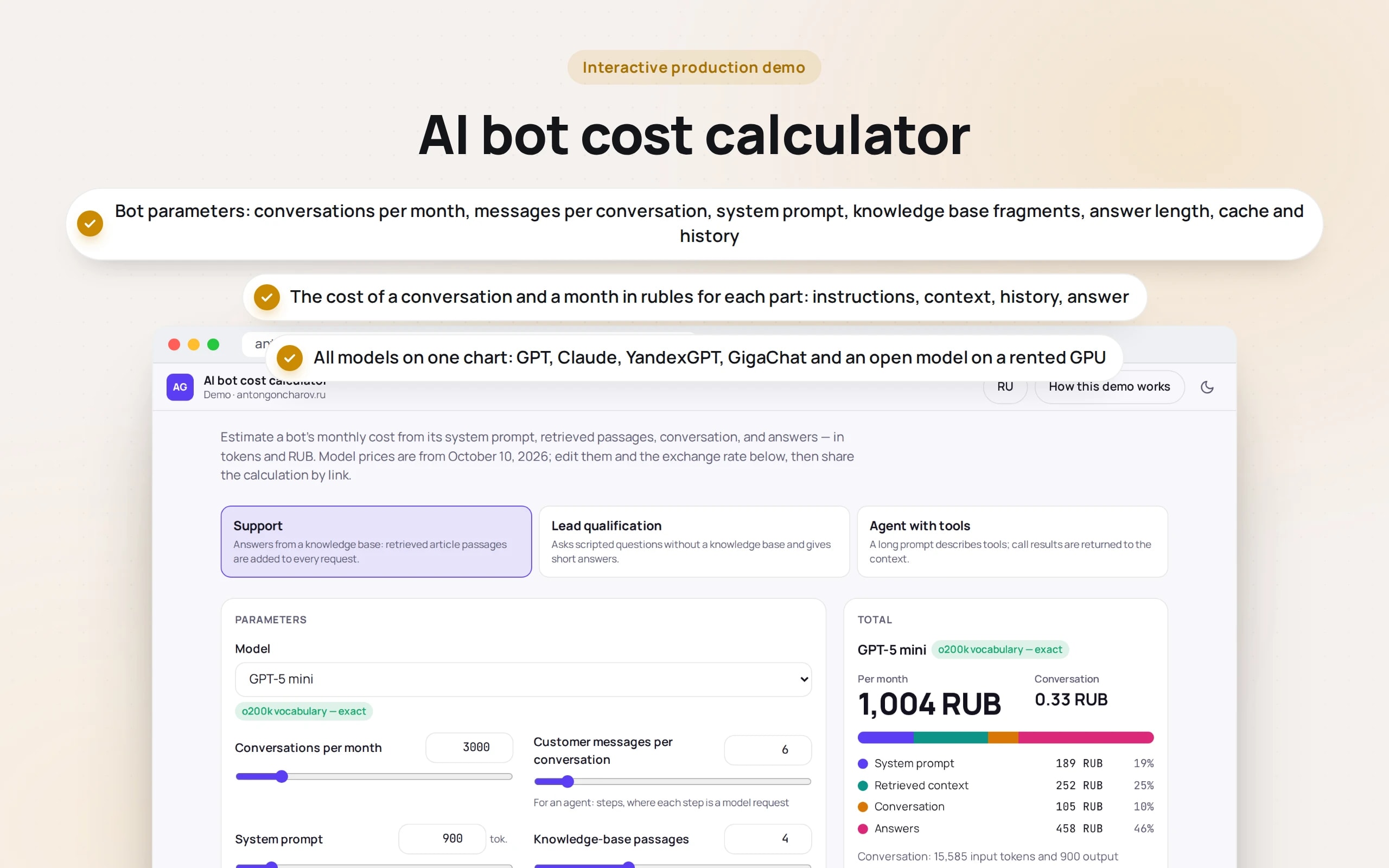
Demo · Web app · AI economics · vanilla JS
AI bot cost calculator
Before launching a bot I calculate what it will cost per month and show how to pay less: prompt caching, fewer fragments, a cheaper model for simple questions.

Demo · Web app · finance · comparison
Mortgage calculator
Overpayment, early repayment and debt-to-income on one screen: you can see what the loan will cost and how to cut the expense.


More on the shelf
Reading
Hands-On APIs for AI and Data Science
Ryan Day
A practical book on building an API for data and connecting AI to it. The running project is a FastAPI service with a database and documentation, then an SDK for it, using the API in analytics and, finally, LangChain agents that call the API themselves.
AI and agentsPythonAPIApplied in 3 projectsReading
Server Applications in Python, Django, Flask and FastAPI
R. S. Bukharev
The path of server-side development in Python, from sockets and protocols to architecture and launch on a server. Django, Flask and FastAPI are covered through real projects: a CRM system, a Telegram bot with server-side logic, a REST API for a mobile app and a WebSocket chat. Separate chapters cover caching and scaling, Docker and Kubernetes, PostgreSQL, MySQL, SQLite and MongoDB, and security: password hashing, JWT and OAuth 2.0, protection against SQL injection, XSS and CSRF, TLS.
ProgrammingPythonBackendApplied in 1 project