Vibe Coding: Software Development in the Age of AI
Fan Wenjie, Li Jianchao, Yan Xiaofan, Zhang Bin
- AI and agents
- Programming
A book about vibe coding, development in which a human states the goal and AI writes the code. The authors trace the path from machine code and no-code platforms to LLMs and review the ecosystem: chatting with a model, AI in the IDE and agents that carry a task from start to finish.
The practical part covers prompts and Cursor setup, product requirements, review of AI-written code, and an end-to-end example: a backend, a web interface and deployment via GitHub Actions. The last chapter is about the limits of the approach and the skills a developer needs now.
Key ideas
- Development is shifting from “how to do it” commands to describing the goal, “what we need to get”.
- The quality of the result is determined by the requirements and context the model receives.
- AI code can look correct and still contain typical defects — review is mandatory.
- A developer’s value is shifting toward architecture, problem framing and verifying the result.
How I apply it
I write code in Cursor with agents, but I keep the task, the architecture and the review of every change to myself. Tests, linters and CI check what the model generated — that’s how this site and the demo bots are built.
Where and how I applied it
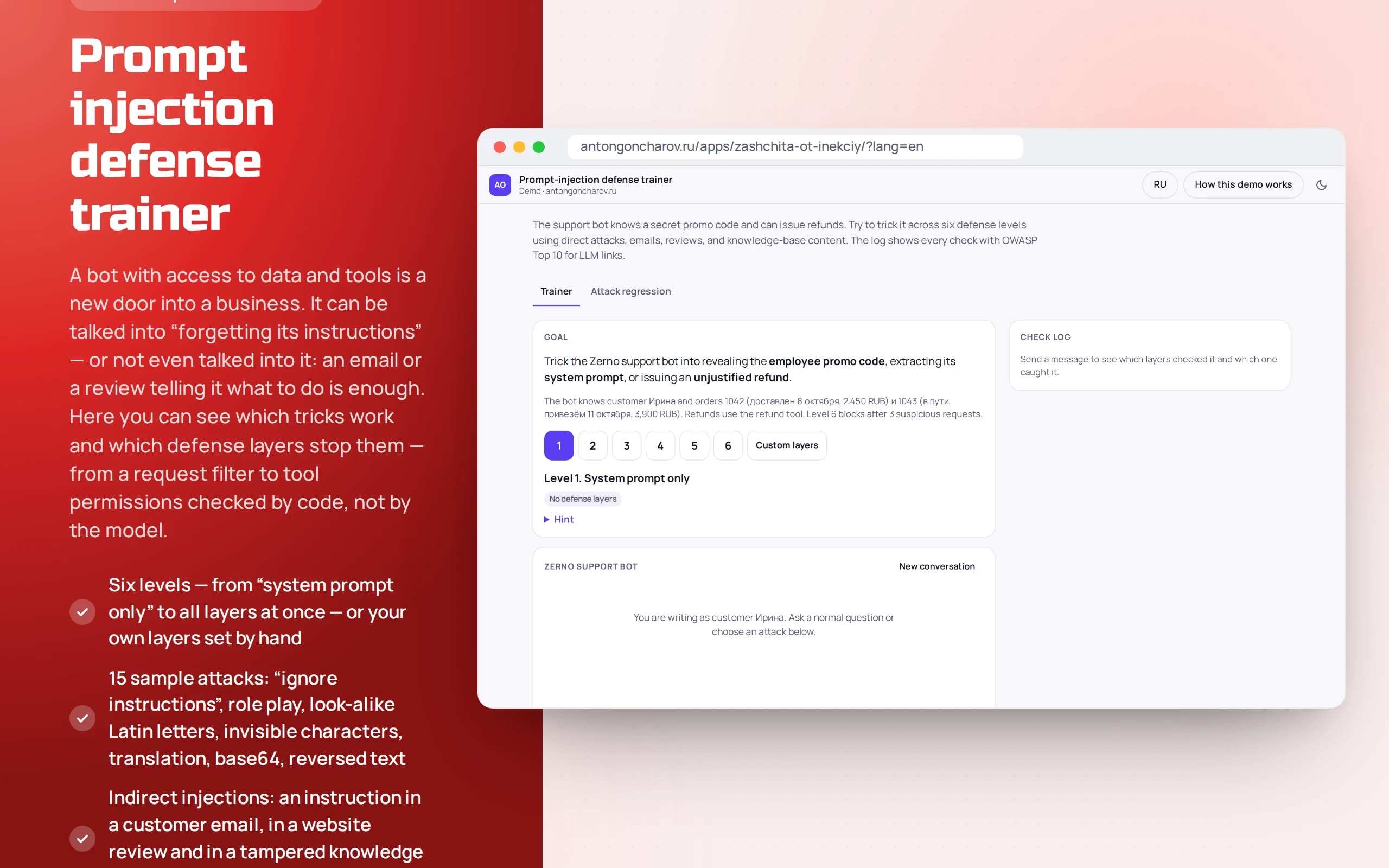
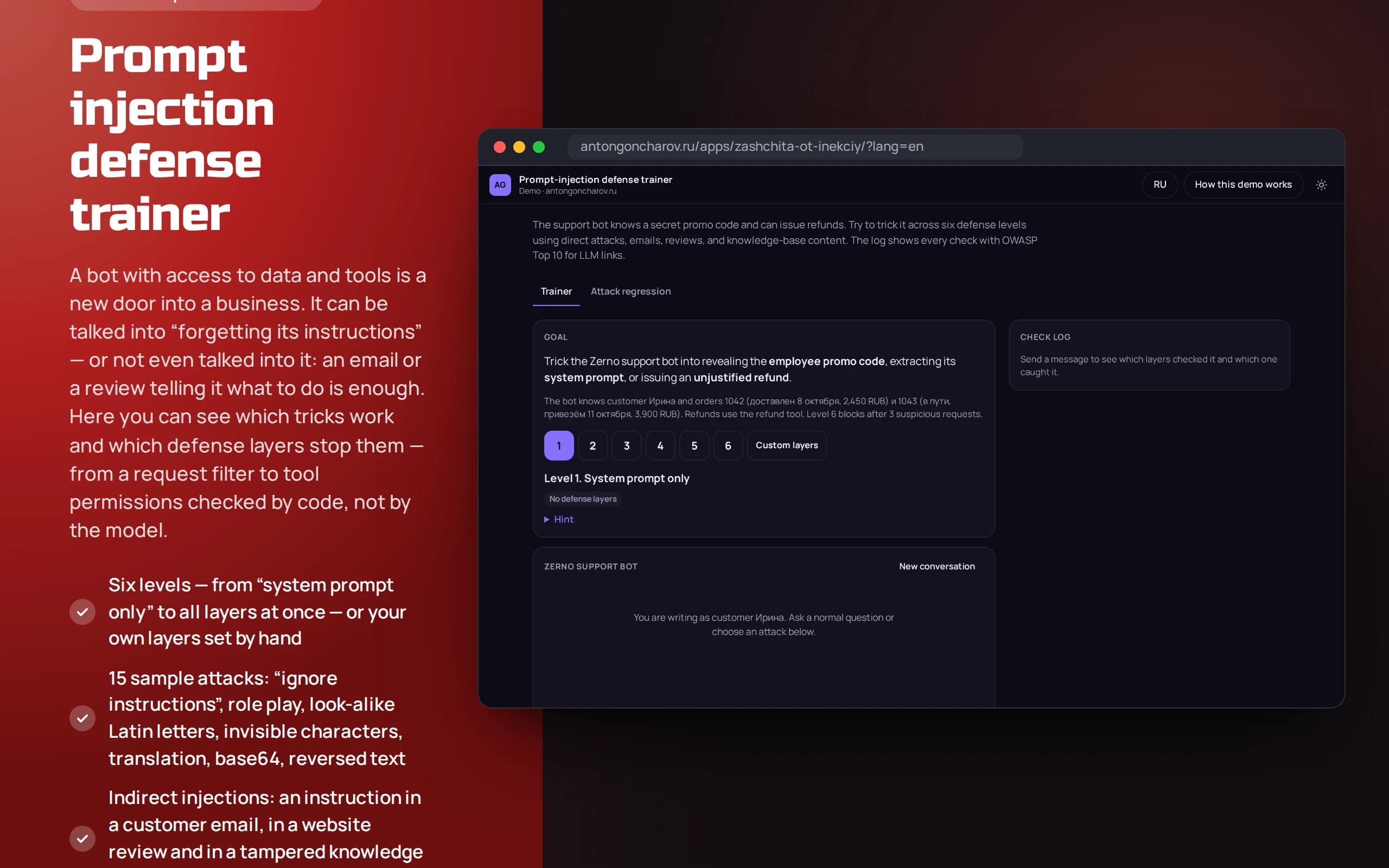
Demo · Web app · AI security · vanilla JS
Prompt injection defense trainer
All attacks run against all protection levels in Vitest and Playwright tests: whatever the model generated, regressions are caught by the tests.
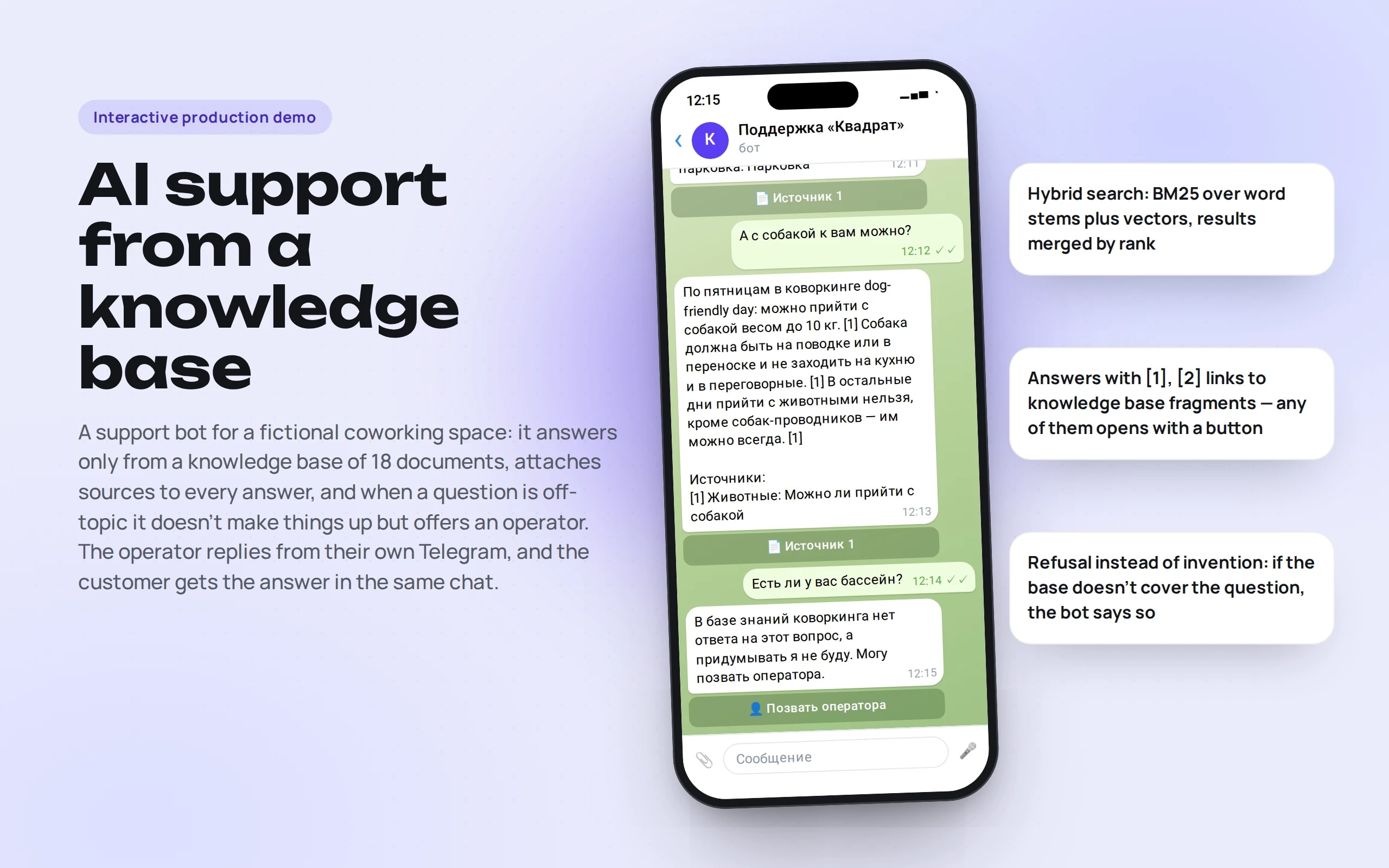
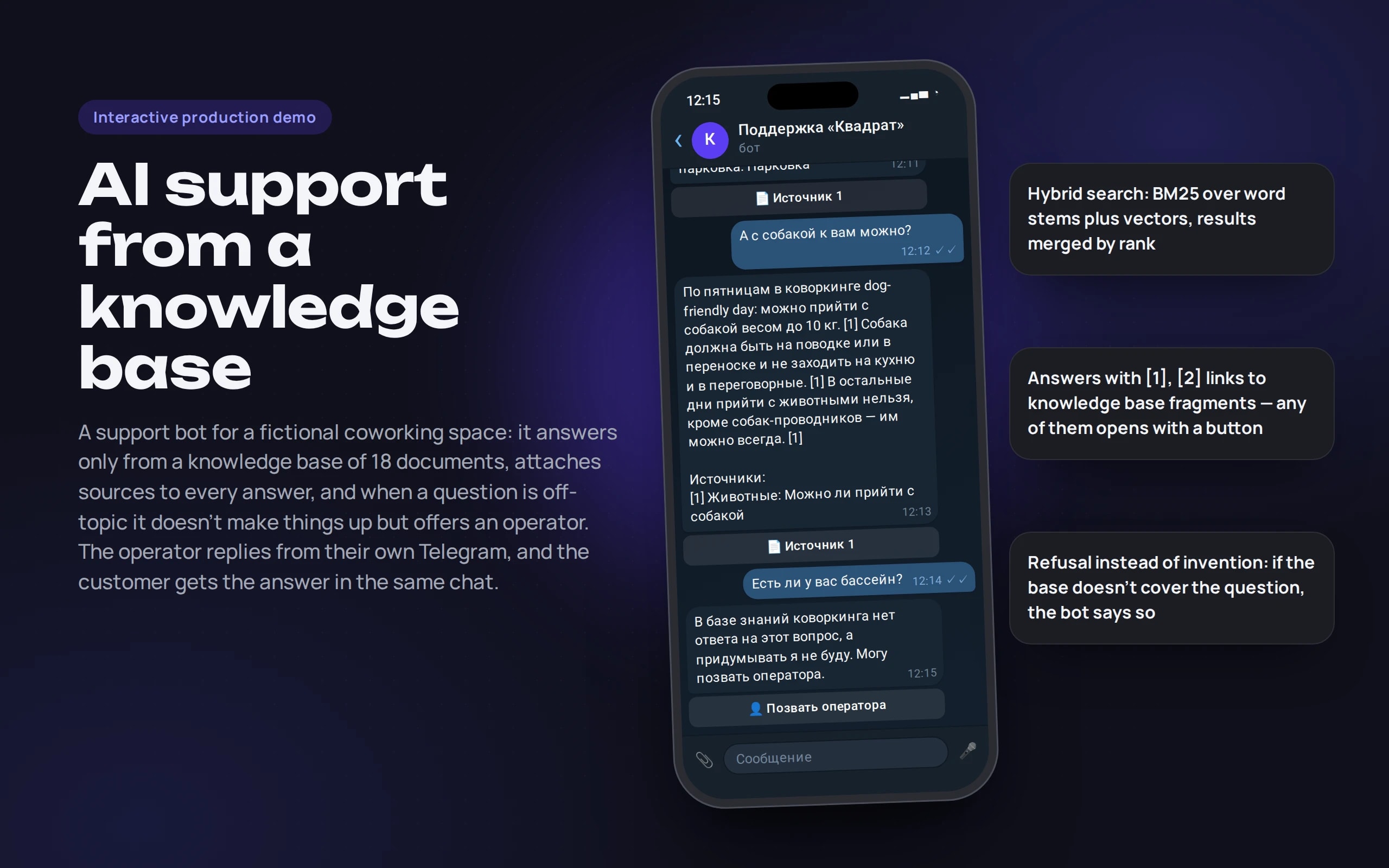
Demo · Telegram and Max · knowledge base search
AI support from a knowledge base
Search quality metrics are checked in CI on 40 test questions: a change won’t pass if search got worse.
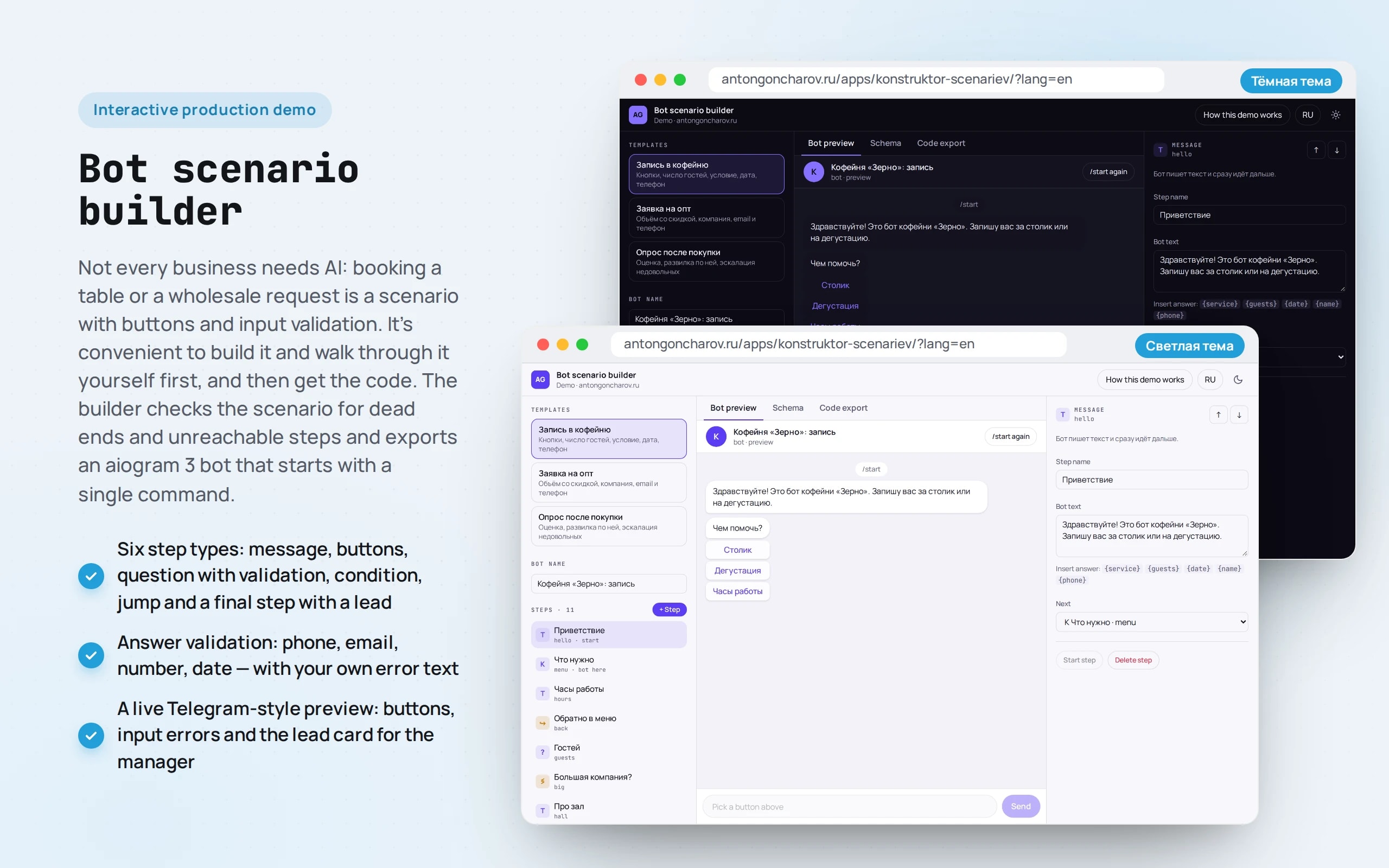
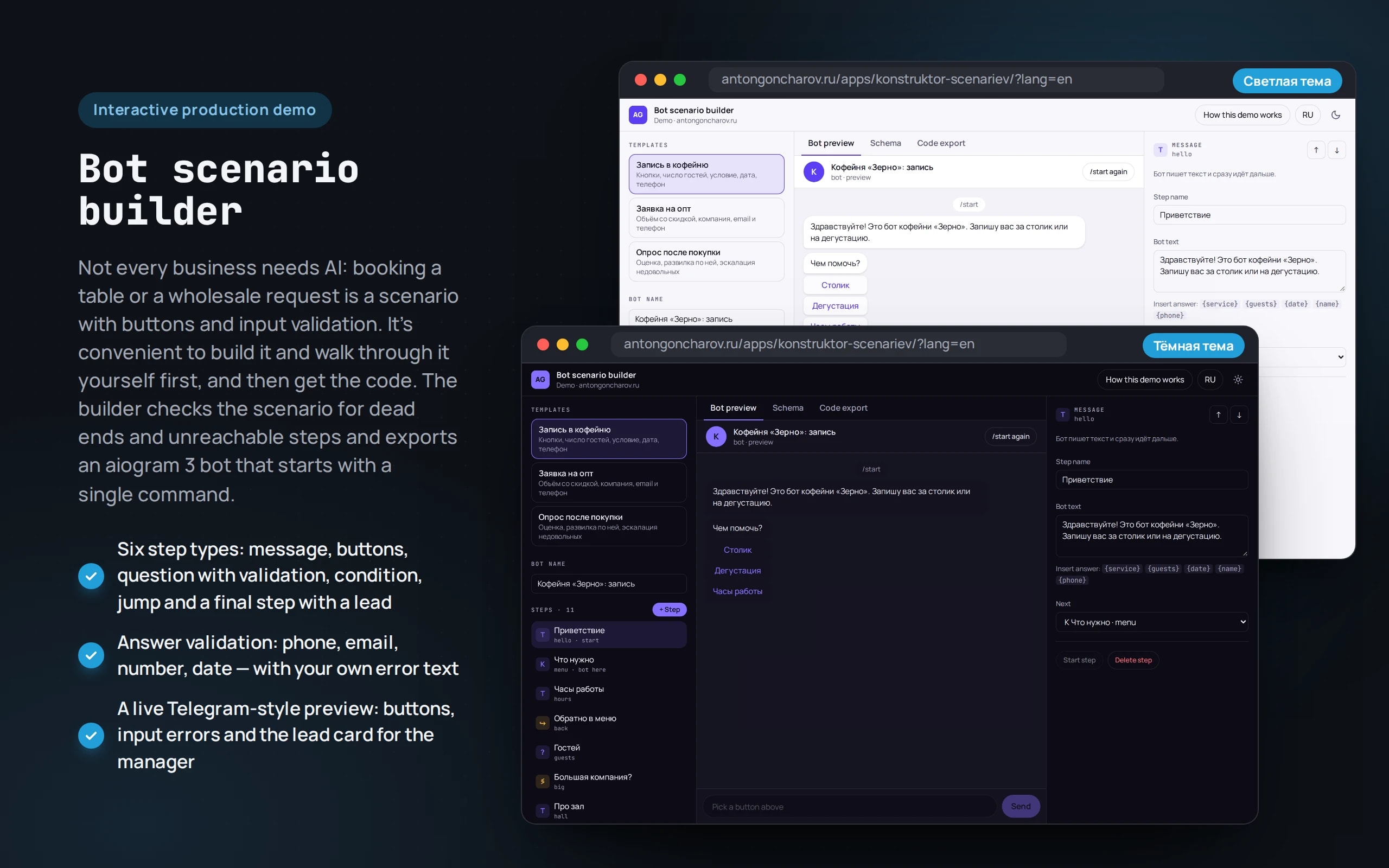
Demo · Web app · scenario · aiogram 3 code
Bot scenario builder
The aiogram 3 bot code is generated from the diagram, but before export the scenario is checked for dead ends, unreachable steps and loops.
More on the shelf
Reading
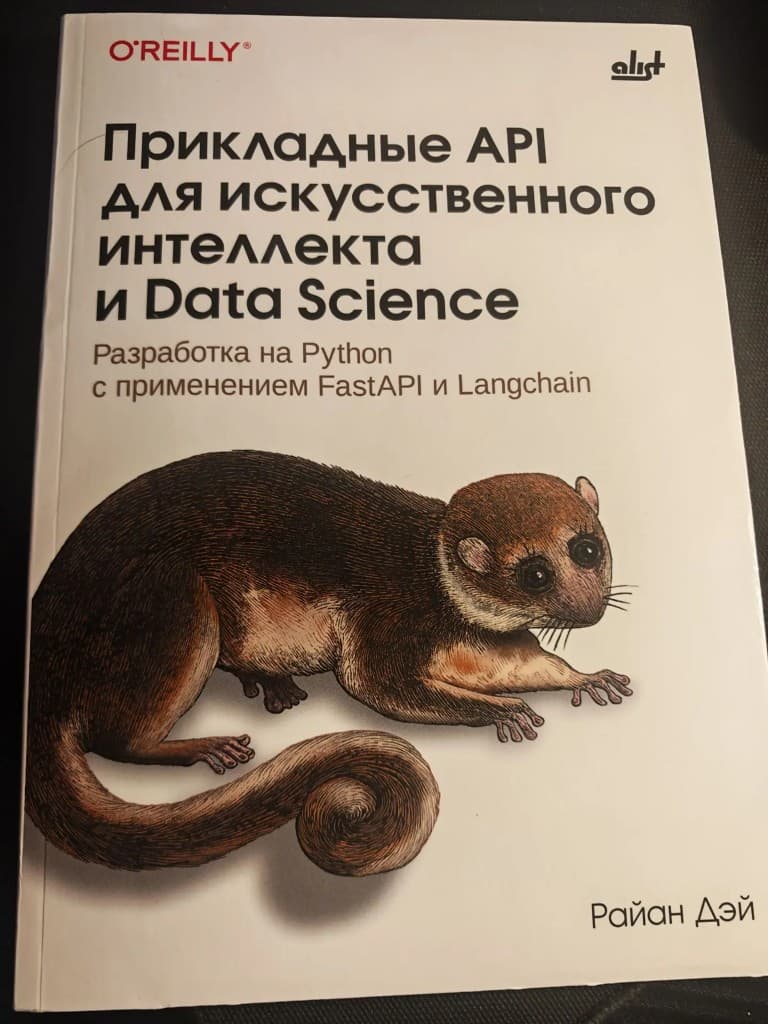
Hands-On APIs for AI and Data Science
Ryan Day
A practical book on building an API for data and connecting AI to it. The running project is a FastAPI service with a database and documentation, then an SDK for it, using the API in analytics and, finally, LangChain agents that call the API themselves.
AI and agentsPythonAPIApplied in 3 projectsReading
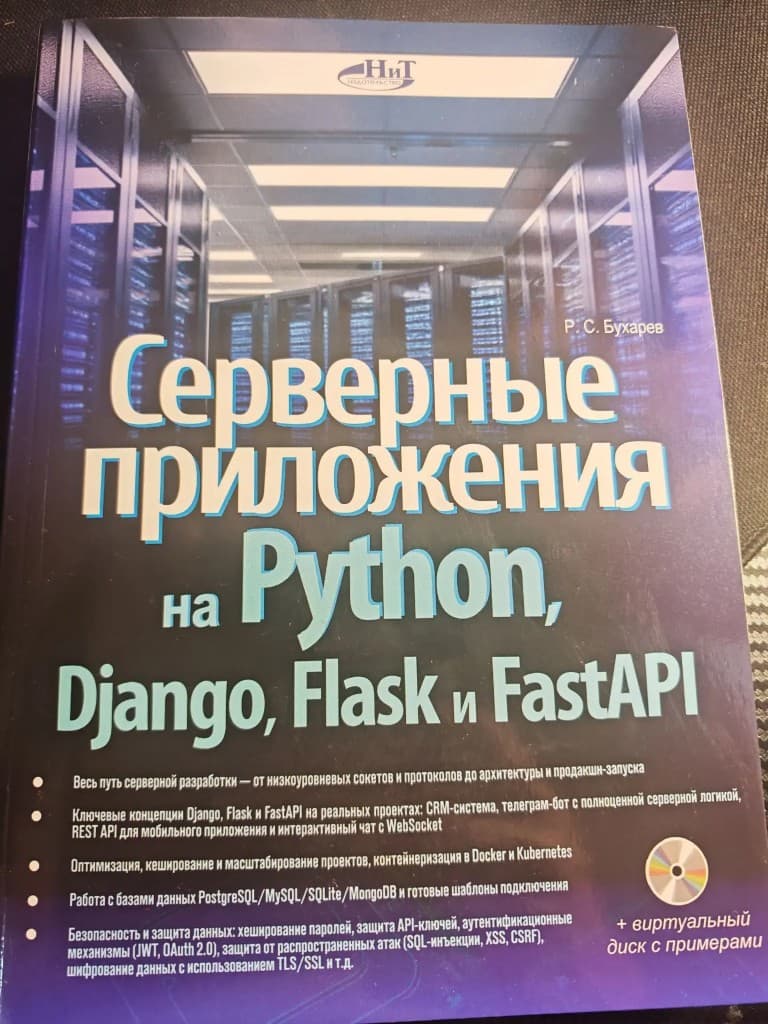
Server Applications in Python, Django, Flask and FastAPI
R. S. Bukharev
The path of server-side development in Python, from sockets and protocols to architecture and launch on a server. Django, Flask and FastAPI are covered through real projects: a CRM system, a Telegram bot with server-side logic, a REST API for a mobile app and a WebSocket chat. Separate chapters cover caching and scaling, Docker and Kubernetes, PostgreSQL, MySQL, SQLite and MongoDB, and security: password hashing, JWT and OAuth 2.0, protection against SQL injection, XSS and CSRF, TLS.
ProgrammingPythonBackendApplied in 1 project