Machine learning in Python · runs in the browser
Marketplace review analytics
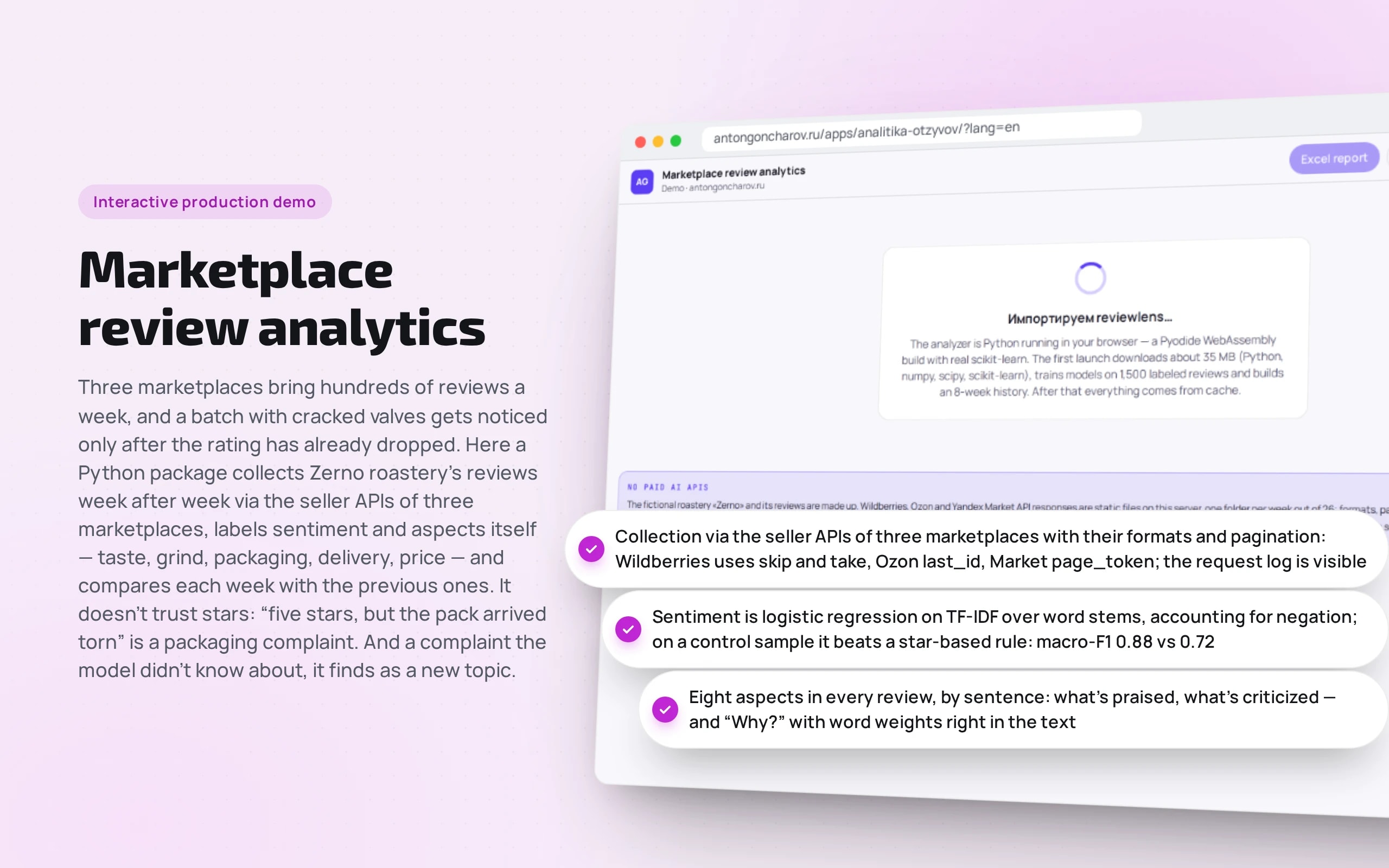
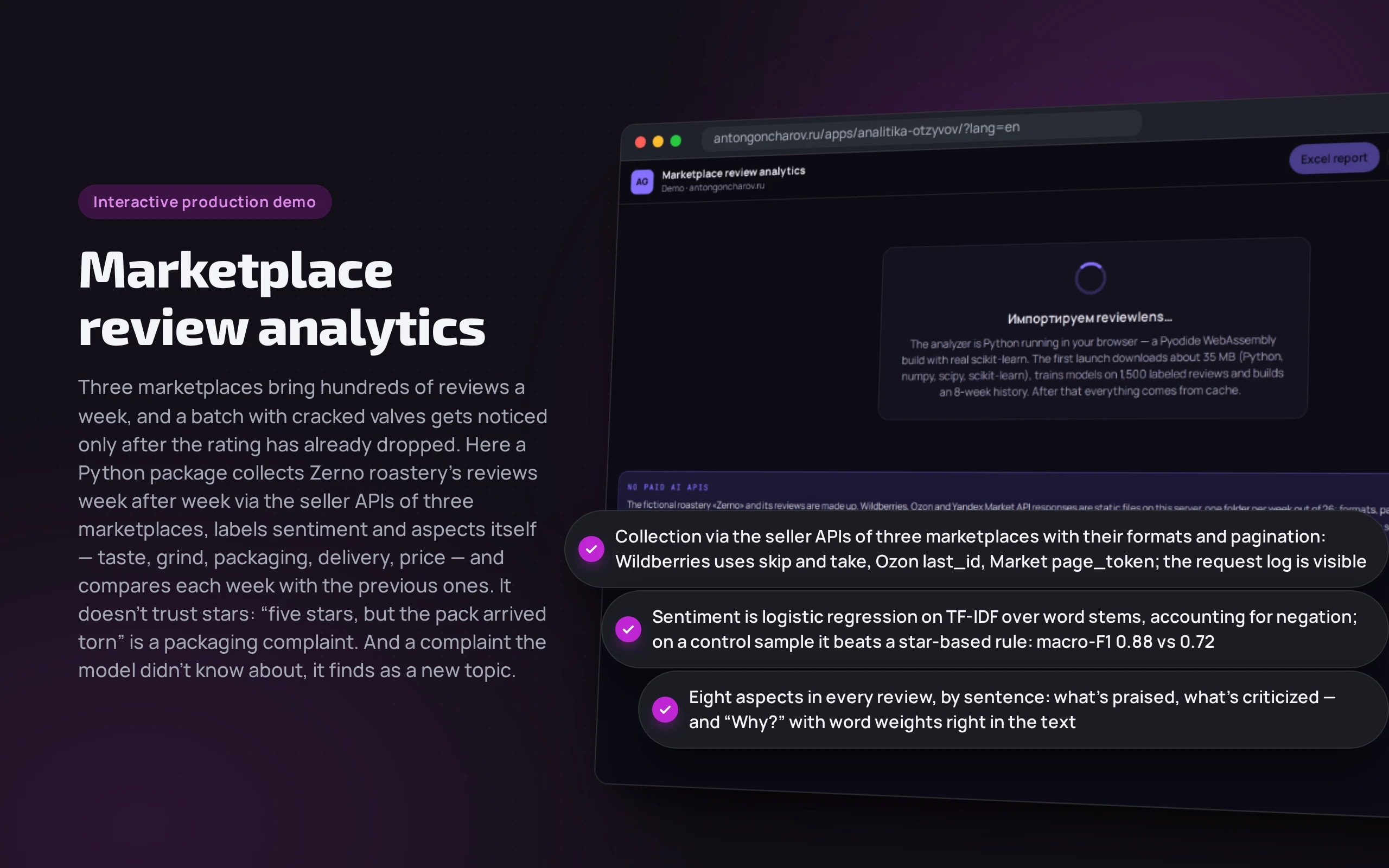
Three marketplaces bring hundreds of reviews a week, and a batch with cracked valves gets noticed only after the rating has already dropped. Here a Python package collects Zerno roastery’s reviews week after week via the seller APIs of three marketplaces, labels sentiment and aspects itself — taste, grind, packaging, delivery, price — and compares each week with the previous ones. It doesn’t trust stars: “five stars, but the pack arrived torn” is a packaging complaint. And a complaint the model didn’t know about, it finds as a new topic.
Scenario: Zerno roastery — fictional, the same as in the quiz and the lead hub: ten coffee, tableware and equipment items on three marketplaces. Six months of reviews are generated, with five incidents hidden in them — from a price increase to short weight.
Open the demo
The first run downloads about 35 MB — Python, numpy, scipy and scikit-learn — and trains the models in a few seconds; after that everything is cached. Best on a computer: the aspect table and charts are wider.
The app runs in your browser: nothing is sent to a server.
What the demo shows
How to try it
Look at the overview
On launch the models train and eight weeks of history are collected automatically. The “Model” tab shows how much more accurate the model is than stars and which words it relies on.
Collect the next weeks
“Collect next week →” — from week ten, price complaints begin; from week fourteen, cracked valves on Wildberries and Ozon. The alert appears in the very first week, and “Show reviews →” opens them.
Correct the model
Press “Why?” under a review, and if the model is wrong, correct the label. The model retrains, and alerts and topics are recalculated.
Reply and discover something new
In the “Replies” tab, publish a draft via the marketplace API. Press “To the end” — the short weight the model didn’t know about appears in the “Topics” tab. Download the Excel file.
No paid neural networks
Zerno and the reviews are fictional. The Wildberries, Ozon and Yandex Market API responses are static files on this same server, a folder for each of 26 weeks; the formats, pagination and reply publishing follow the marketplaces’ documentation. The models are real scikit-learn in the Pyodide WebAssembly build, without paid neural networks: reply drafts are assembled from templates. The same package is tested with pytest on regular Python and runs on a server with a single command.
The demo runs without OpenAI, YandexGPT or GigaChat API keys. Wherever a production system calls a model, there’s a local stub with the same interface — so the demo is free, always available and never makes things up.
What a production project adds
- Scheduled collection on a server with seller tokens, history in PostgreSQL
- The model retrains on managers’ labels, with quality checked in CI on a control sample
- Telegram alerts with buttons: open the reviews, take it on, pass it to production or logistics
- Reply drafts from a language model following your rules, published after approval
- A weekly Excel report by email and a dashboard by product and marketplace
Stack
- All demos by stack:
- Python
- React
- TypeScript
- Python 3.14
- scikit-learn
- pandas
- openpyxl
- pytest
- Pyodide
- WebAssembly
- Web Worker
- Comlink
- React 19
- TypeScript
- Recharts
- Zustand
Based on
Books and university courses whose ideas are at work in this demo.
Book · D. M. Koltsov
Python by Example: Practice, Practice and Only Practice
Each marketplace has its own source class with a shared fetch method, so Wildberries, Ozon and Yandex Market go through the same code; sentiment and aspects run on scikit-learn.
Book · Alexey Vasiliev
Python Programming in Examples and Exercises
Reviews from Wildberries, Ozon and Yandex Market are collected at the same time, each marketplace with its own pagination.
University course · CMC MSU
Operating Systems
Python runs via Pyodide in a separate Web Worker: the models train without blocking the page.
Developer’s comment
Anton Goncharov
AI systems developer · Python
For business
- A spike in complaints is visible in the very first week — before the listing’s rating drops.
- Stars can’t be trusted: the model finds a complaint in a five-star review and praise in a three-star one.
- Problems nobody thought of surface on their own — like short weight in this demo.
For developers
- scikit-learn in the browser via Pyodide: TF-IDF over word stems with negation handling and character n-grams, logistic regression, aspects as one-vs-rest.
- Alerts are a binomial z-score for a week, marketplace and product against the six weeks before it, with a higher threshold for narrow slices.
- Quality is checked on a held-out set: macro-F1 of 0.88 versus 0.72 for a star-based rule. The same package passes pytest in CI.
Tips
Tip 01
Compare the model with a simple rule: if it doesn’t beat it, you don’t need it.
Tip 02
For alerts, calculate statistical significance, not percentages: on small numbers percentages lie.
Want the same for your business?
Tell me about your task — I’ll tell you what from the demo fits, how long it will take and what I’ll need from you.
Other demos in this section
All demos- live

Web app · speech recognition · neural network in the browser
Voice request
A customer dictates a request by voice, and the manager gets a ready card: name, company, phone, budget, timeline, task and a score — hot lead or not. Speech is recognized by Whisper right in the browser.
- React
- TypeScript
- In-browser neural network
- live

Web app · call in the browser · speech recognition and synthesis
Voice delivery operator
A robot takes phone orders instead of the host: it listens, asks again, checks the address against delivery zones, totals the order and reads it back before confirming. The call runs right in the browser — a “Call” button, no phone number.
- React
- TypeScript
- In-browser neural network
- live

Web app · speech recognition · sales team quality control
Call speech analytics
A sales call becomes a transcript by role, a score against the script and a completed deal card: customer, contacts, interest, the quoted price, the next step and a task for the manager. Speech is recognized by Whisper right in the browser.
- React
- TypeScript
- In-browser neural network
- live

Web app · documents · DOCX and PDF
Proposal and contract generator
A manager fills in a deal form — buyer, products, discount, VAT — and the commercial proposal, supply contract and invoice are assembled on an A4 page before their eyes. The output is Word, PDF or JSON.
- React
- TypeScript
- live

Web app · B2B · proposal in PDF
Price configurator
A manager builds an order for all the windows in an apartment: type, size, sashes on a diagram, profile, glazing unit and color. Production rules are checked instantly, discounts and installments are calculated automatically, and a numbered proposal goes out as a PDF.
- React
- TypeScript
- live

Web app · finance · comparison
Mortgage calculator
Five bank programs on one screen: which suit the client and why the others don’t. A developer-subsidized rate, differentiated payments, early repayment, debt-to-income ratio and the tax deduction.
- React
- TypeScript
- live

Web app · estimate · PDF
Renovation estimate calculator
Room dimensions turn into floor, wall and ceiling areas, and those into work by stage. Labor and materials separately, the timeline based on crew output, a payment schedule and estimate versions for negotiating with the client.
- React
- TypeScript
- live

Web app · storefront · checkout · orders
React SPA catalog
A whole store in the browser: search with suggestions and keyboard layout correction, facets with live counters, links to any filter, favorites, a cart with a promo code and checkout with a delivery slot. Orders are visible in “My orders” with statuses and can be repeated or cancelled.
- React
- TypeScript
- live

Website widget · vanilla JS · one line
AI consultant widget
A consultant for any website, installed with a single line: it answers from a knowledge base with a link to the source, collects requests and calls an operator. Written in plain JavaScript without frameworks — the whole widget is 21 KB gzipped.
- Vanilla JS
- live

Website widget · vanilla JS · leads
Quiz lead form
A quiz instead of a long form: six questions with branching and a price estimate at the end. The manager gets a lead rated “hot / warm / cold” with its ad source, and the “Analytics” tab shows at which step people leave.
- Vanilla JS
- live

Python backend · webhooks → amoCRM and Bitrix24
Lead integration hub
Leads from the website, ads, calls, email and bots arrive at webhooks, are normalized, checked for duplicates, routed to managers and delivered to amoCRM and Bitrix24 — with retries when the CRM is unavailable.
- Python
- React
- TypeScript